FIFA World Cup 2026: When the World Shows Up, Something Beautiful Happens
Something happened in Boston a couple of weeks ago that stopped me in my tracks. It was cool.
An estimated 50,000 Scottish fans—kilts, bagpipes, red John McGinn jerseys, and all—descended on a city already steeped in Irish-American pride and turned it into something neither city had ever quite experienced before. They marched through the streets singing. They took over Fenway Park alongside Red Sox Nation on “Scottish Heritage Celebration Night.” They put traffic cones on the heads of statues. They cheered a local cop as he juggled a soccer ball. They ran the bars out of Tennent’s Lager so completely that Sam Adams ran dry, too. And through all of it—the noise, the volume, the sheer joyful takeover of the city—there was not a drop of anger, not a moment of ugliness.
The Boston Globe ran a full-page tribute. Mayor Michelle Wu suited up in a pink Scotland jersey to sign a letter of intent establishing a sister-city partnership between Boston and Glasgow. The Scottish national team, on their way to Miami for their next match, left behind a thank-you note that read: “You made us feel part of your incredible city.”
The Boston Globe returned the love: “You turned train stations into singalongs, Fenway into a football ground, and an ordinary June into something we'll be talking about for years.”
I keep coming back to that image. Not because it’s remarkable that people from Scotland know how to throw a party (they clearly do), but because of what it reveals. When people gather around something they love, something transcendent happens. The philosopher Émile Durkheim called it collective effervescence, or “social glue”—the powerful charge of energy and unity that arises when human beings share a common purpose. The World Cup, in city after city across this country right now, is generating that force at a scale rarely seen.
And honestly? America has been warming up to this for a while. When Ted Lasso hit Apple TV+ a few years ago, something unexpected happened: millions of Americans who couldn’t have told you the offside rule fell in love with a show about soccer, not because of the sport, but because of what the sport made possible. Kindness, belief, a locker room that chose each other, and a coach who led with his whole heart and refused to let winning be the only thing that mattered. Ted Lasso didn’t just make soccer more accessible to Americans; it reminded us what community looks like when it’s done right. The World Cup showing up on American soil is that same invitation, just at a global scale.
This Is What America Looks Like When It Opens Its Arms
Let’s be honest about the moment we’re living in. The United States is hosting the FIFA World Cup 2026 while simultaneously navigating one of the most fractured chapters in its modern history. The divisions are real. The noise is loud. And yet, across Boston, Atlanta, Kansas City, Dallas, Los Angeles, Seattle, and more, something else is happening at the same time.
In Lawrence, Kansas, a college town of under 100,000 people, roughly 500 residents and students waited to greet the Algerian national team when they arrived for training. Storefronts flew green, white, and red flags. The university marching band played the Algerian national anthem. In Boston’s City Hall Plaza, a young man named Deu Awouk, who moved to the city from South Sudan three years ago, stood at a FIFA Fan Festival and described what he was witnessing as “seeing all these people from different worlds—different parts of life—come together and enjoy the beautiful game together.”
Fans from across the globe came to this country carrying their own assumptions about America, about Americans, about what they'd find here. And many of them found something different from what they expected: generosity, curiosity, warmth. That’s what sport at its best does; it erases the lines. Instead of separate, we’re together.
There are people in this country right now rooting hard for Iran. For Panama. For Morocco. For teams from nations whose governments are in deep tension with ours. And you know what? That’s not a contradiction. That’s humanity. When you love the game—when you love the competition, the craft, the story of an underdog—you can cheer for another country’s people even when politics says you shouldn’t. Soccer doesn’t ask you to sort that out. It just asks you to watch.
That is a form of connection that no policy, platform, or press release can manufacture.
The Global Game Is Already Here, Right in Our Backyard
And I do mean right here.
While the World Cup matches themselves are being played in cities like Boston, Dallas, and Los Angeles, the Triad has quietly become one of the most internationally significant addresses in this tournament. Norway, led by Erling Haaland, one of the most electric players on the planet, chose Greensboro as its official Team Base Camp, training at UNCG’s soccer facilities and staying at the Grandover Resort (less than 3 miles from our house in Jamestown). More than 20,000 people requested tickets for their open training session alone, in a stadium that seats roughly 3,500. Germany, one of the sport’s most storied programs, set up camp at Wake Forest University in Winston-Salem, training at the Graylyn Estate. Scotland—yes, the same Scotland that turned Boston upside down—made Charlotte their home base.
Three FIFA World Cup nations. Three North Carolina cities. All within an easy drive of each other.
The project manager for Norway said they searched eight different locations before choosing Greensboro. What drew them? The quiet. The green. The sense that this place could give its players focus and peace before the biggest stage in the world. That’s not a small thing. It’s the Triad, on a global stage, being exactly who we are.
I’ve been thinking a lot about what community actually looks like. Not just the idea of it, but the thing itself.
I grew up playing soccer—organized leagues, then high school—back when the sport was still finding its footing in America (or at least in East Tennessee). It was, in a sense, the early days of the game here, and we knew it. My daughter Allison started playing at age 5, went on to play on championship travel teams, and then was a four-year team captain in college. My oldest son Tyler has been a World Cup fanatic for years, following the tournament the way some people follow their own religion. Soccer has been woven into our family for a long time.
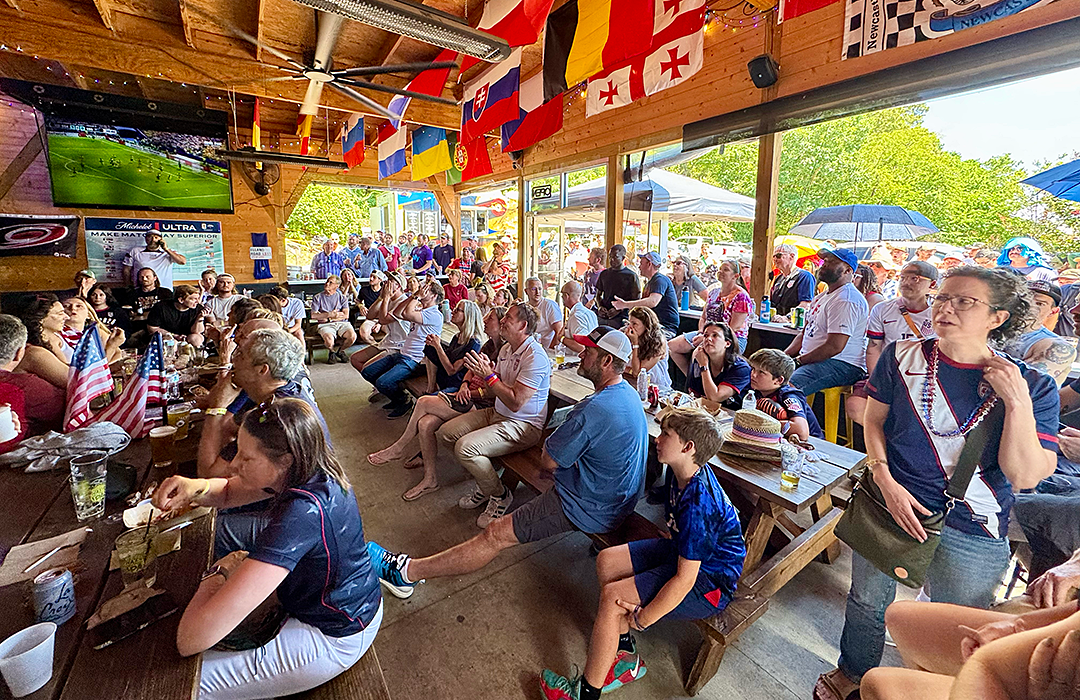
Ready for the USA / Australia World Cup Match, Father’s Day weekend, 2026, at Olde London Road Pub in Asheville, NC
A few weeks ago, on Father’s Day weekend, I made my way to Asheville to spend time with Tyler and his wife (my daughter-in-law), Alex, who call it home. My daughter Allison made the trip over to join us. Tyler and Alex’s favorite spot—the place they return to again and again throughout the year—is Olde London Road pub, a place whose entire identity, year-round, is built around international soccer. We found ourselves there, along with Tyler and Alex’s friends Matt, Haley, and Zack, packed shoulder to shoulder with hundreds of other soccer fanatics, to watch the United States play. The energy in the pub—inside, outside, and in the overflow spaces near the parking lot—was electric, the kind that only happens when strangers become a crowd with a common cause. We stayed for Scotland’s match afterward, then another. We made a full day of it, alongside what felt like half of Asheville, all of us caught up in something larger than ourselves.
That’s the feeling. That is what I want people to understand.
It causes me to think about what happens at a Carolina Core FC match at Truist Point Stadium in the heart of downtown High Point. For those of you who haven’t been, let me tell you what you’re missing. Carolina Core FC isn’t just a professional soccer club, though they are that, competing in MLS NEXT Pro and building something real on the field. What they’ve built at Truist Point is a gathering space. A place where the diverse fabric of this region—the Latino families, the immigrant communities, the longtime Triad residents, the young professionals, the kids who’ve never had access to this level of play—all find themselves standing in the same place, cheering for the same thing.
It’s not an accident. Instead, it’s the explicit mission.
Carolina Core FC was founded on the belief that the world’s game could serve as a vehicle for something larger than soccer. Their own words: “a long-term investment in individuals and communities with untapped potential, serving as a major driver of economic development in the Core Region.” I've had the chance to sit with the club's president, Andy Smith, and geek out over all of it. They’ve backed that up with action: free soccer clinics for underserved communities, a fully funded, no-barriers MLS NEXT Academy, youth development pathways designed to create great people, not just great players, and a stadium experience engineered for genuine fan connection.
Their name itself—Carolina Core—celebrates 12 diverse, interlocking cities across a region that is often overlooked. High Point, Greensboro, Winston-Salem, Asheboro, Burlington. This is a region with deep roots in furniture manufacturing and tobacco and textile heritage, home to growing immigrant and refugee communities, to historically Black colleges and universities, to Latinx families who have called this place home for generations. Carolina Core FC looked at that complexity and essentially said, “This is who we are, and we’re going to build something that belongs to all of it.”
We are not talking about a tagline. We are talking about a theory of change.
And it’s one we share. Boys & Girls Clubs of the Greater Triad is proud to be a collaborative partner with Carolina Core FC. Our Club kids and families have had the opportunity to experience matches firsthand, not just as spectators but as participants in something larger than themselves. We’re working together on soccer clinics and a planned collaboration tied to our new BGCTriad Athletics League, with more on the horizon. When Carolina Core FC talks about building community through the beautiful game, that’s not abstract to us. We’re in it with them.
What the Tartan Army Taught Us — and What It Means Here
Here’s what made the Scotland story in Boston so striking to me beyond the spectacle: they came in as themselves. Full kilt, bagpipes, and bravado voice. And they didn’t demand that Boston become something different to accommodate them. They just brought joy so openly, so freely, that Boston couldn’t help but join in.
That’s the template. It’s not assimilation or performance. Just presence—authentic, celebratory, community-rooted presence—and the gravitational pull it creates.
Carolina Core FC does that at the local level. Every match night at Truist Point Stadium is, in some small but real way, what the Boston Globe was describing at a city scale. People who don’t necessarily share a zip code, a language, a background, or a political worldview find themselves on their feet together because somebody just put one in the back of the net.
I’ve been to those matches. I’ve felt it, and it’s not magic. At its very core, it’s community. And it’s being built intentionally right here in High Point, NC.
Go. Be There.
We are living through a World Cup on American soil for the first time in 32 years, and the world is showing up. People are watching Iran play in Tehran’s Book Garden and in living rooms across the Triad. They’re watching Brazil, Scotland, Morocco, and the US Men’s National Team and feeling something that belongs to all of us.
That spirit lives locally, too. Carolina Core FC is giving our region its own version of that gathering place; a space where the global game becomes a local story, where community isn’t aspirational but actual, where economic development and social connection happen on the same pitch.
If you haven’t been to a match, go. Take your kids. Take your neighbor who just moved here from another country. Take the colleague you’ve never quite connected with outside the office. Take somebody who doesn’t know anything about soccer and let the crowd do the rest.
The Beautiful Game has a way of showing us who we could be, together. That’s worth something right now. It’s worth a lot.
Vamos Foxes!
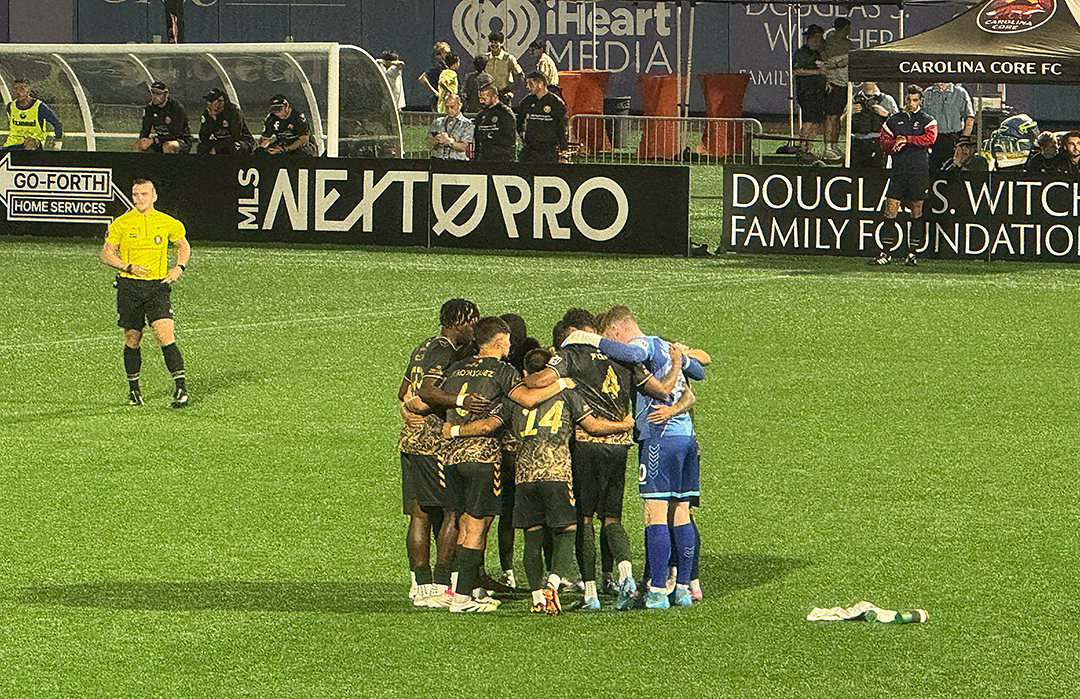
Carolina Core FC at the start of a match, 2026
William D. Gibson is President & CEO of Boys & Girls Clubs of the Greater Triad (BGCTriad), serving youth across High Point, Greensboro, Winston-Salem, and the surrounding Core Region. He writes on leadership, community, and positive social change.