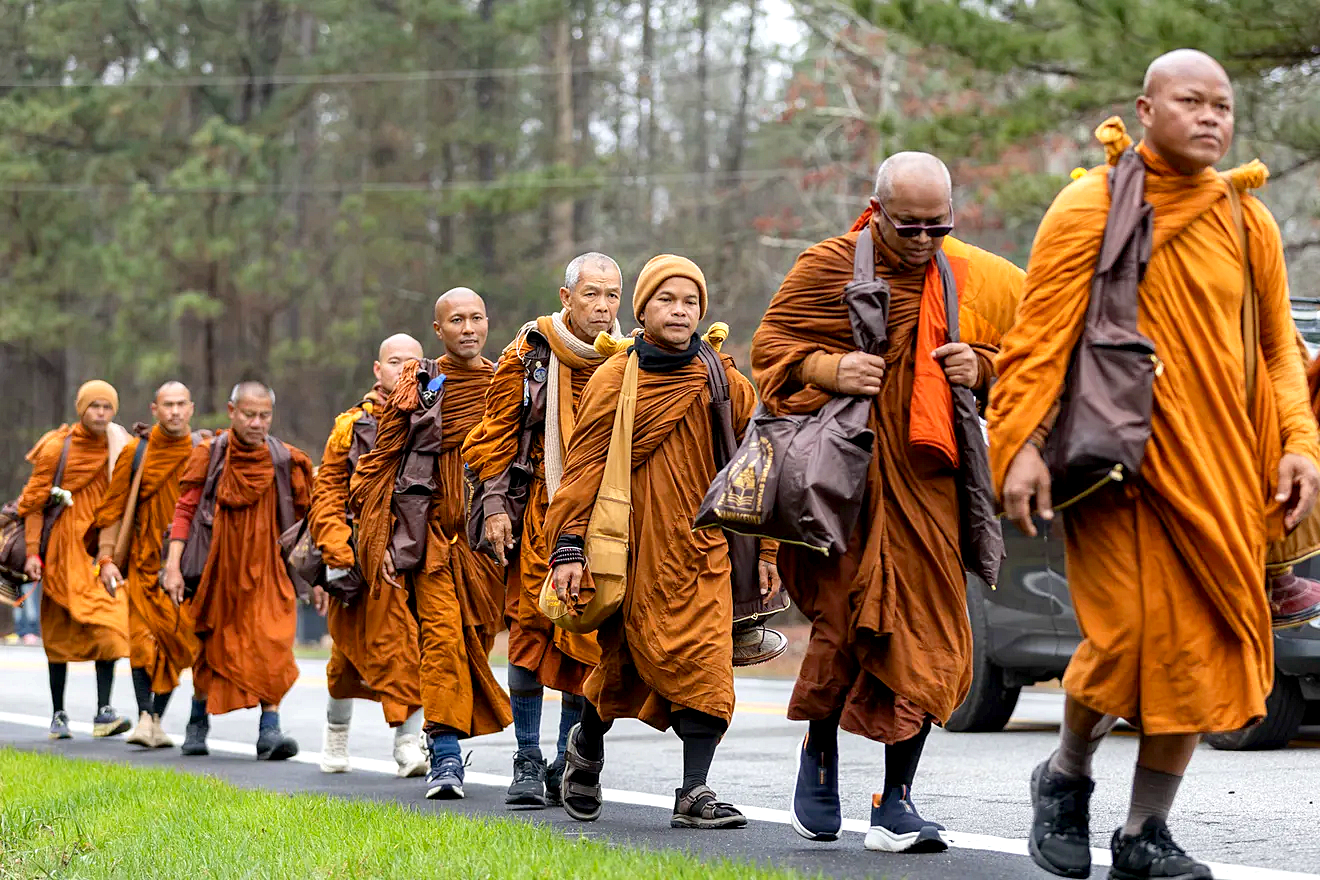
The Buddhist monks’ long walk toward Washington, D.C. has quietly captured the attention of many Americans—and reminded me of something important. There are moments in our shared life when progress does not arrive with urgency or spectacle, but through movement that is slow, deliberate, and sustained. Real change often looks less like a breakthrough and more like a long walk—taken step by step, without certainty about how far the road will stretch ahead.
This is especially true in times of moral tragedy—through loss, grief, a collective pause, or the experience of broken justice. When the ground feels unsteady or the steps awkward and challenging, we are tempted to measure impact quickly, to look for results we can point to, or reassurance that the effort is working.
But most of the work that actually matters has never moved that way.
Doing good is often quiet before it is visible. The long game of justice, equity, and human dignity rarely announces itself with clarity or consensus. History has a way of smoothing the edges of moral leadership—we admire the arc of change while ignoring how uncertain it looked while it was bending.
Dr. Martin Luther King Jr. understood this. In his own time, his work was not universally celebrated. He was criticized across the political spectrum—labeled disruptive, impatient, and unrealistic—and urged to wait for a “better moment.” Many who now invoke his name were deeply uncomfortable with his methods and unsettled by his insistence that justice delayed was justice denied.
Dr. King was not playing to the moment. He was committed to the long game. He understood that moral progress requires endurance—that justice demands more than good intentions or symbolic gestures. That lesson feels especially relevant now.
From my own experience, the most meaningful work I’ve been part of did not arrive with applause. It arrived slowly—through trust built one step and conversation at a time, through adversity that forced reflection, through moments when progress felt fragile or reversible. Staying committed required faith not just in the outcome, but in the process itself.
That kind of faith is not passive. It is active, disciplined, and demanding.
Dr. King spoke of faith not as certainty, but as trust in a moral arc that bends only because people are willing to put their hands on it. That bending is slow. It’s uneven and entirely dependent on collective effort sustained over time.
Doing good rarely looks impressive at first because it is not designed to impress. It is designed to endure. And sometimes, enduring means being willing to step into discomfort—to challenge systems, question norms, and create the kind of necessary disruption that moves us closer to justice. Not for the sake of noise or notoriety, but because conscience demands it.
The long game has always required that kind of courage—the courage to take the next step, or to remain, and, when needed, to get into good trouble for the sake of something better than ourselves.
Keep putting one foot in front of the other. The work moves forward because you do. It matters.